The Perimenopause Prep Kit
You have eleven minutes. Walk in with more than “I’ve been feeling off.”
A 90-day symptom record, an appointment plan, and the words to use when you’re not being heard.

You know something has changed.
You’ve been waiting six weeks for this appointment.
You get eleven minutes. And somewhere between “how have you been feeling” and the door, everything you meant to say collapses into I’ve just been really tired lately.
Then you drive home and remember the other nine things.
The sleep that stopped working eight months ago. The rage that arrives out of nowhere and leaves you apologizing to your kids. The word you couldn’t find in a meeting last Tuesday. The joint pain you assumed was unrelated. The fact that you don’t feel like yourself and haven’t for a while.
None of it made it into the room.
It isn’t that you forgot. It’s that memory is bad at this.
Symptoms that come and go are almost impossible to report accurately.
On a good week you’ll understate it, because right now you feel fine and it’s hard to summon how bad the last one was. On a bad day you’ll overstate it, because it’s all you can think about.
Neither version is the truth. And the truth is what gets you taken seriously.
So you say “I’ve been feeling off,” which is easy to set aside. Meanwhile the thing that would actually change the conversation — how often, how badly, since when, and getting worse or better — is sitting in your head in pieces.
One sentence changes the appointment.
Not this one:
“I’ve been really tired and my sleep is bad.”
This one:
“I’ve tracked this for ninety days. It clusters in the week before my period, five days at a time, and the runs have been getting longer since March. I’m averaging four and a half hours of sleep and I’ve missed six days of work.”
Same woman. Same symptoms. Completely different appointment.
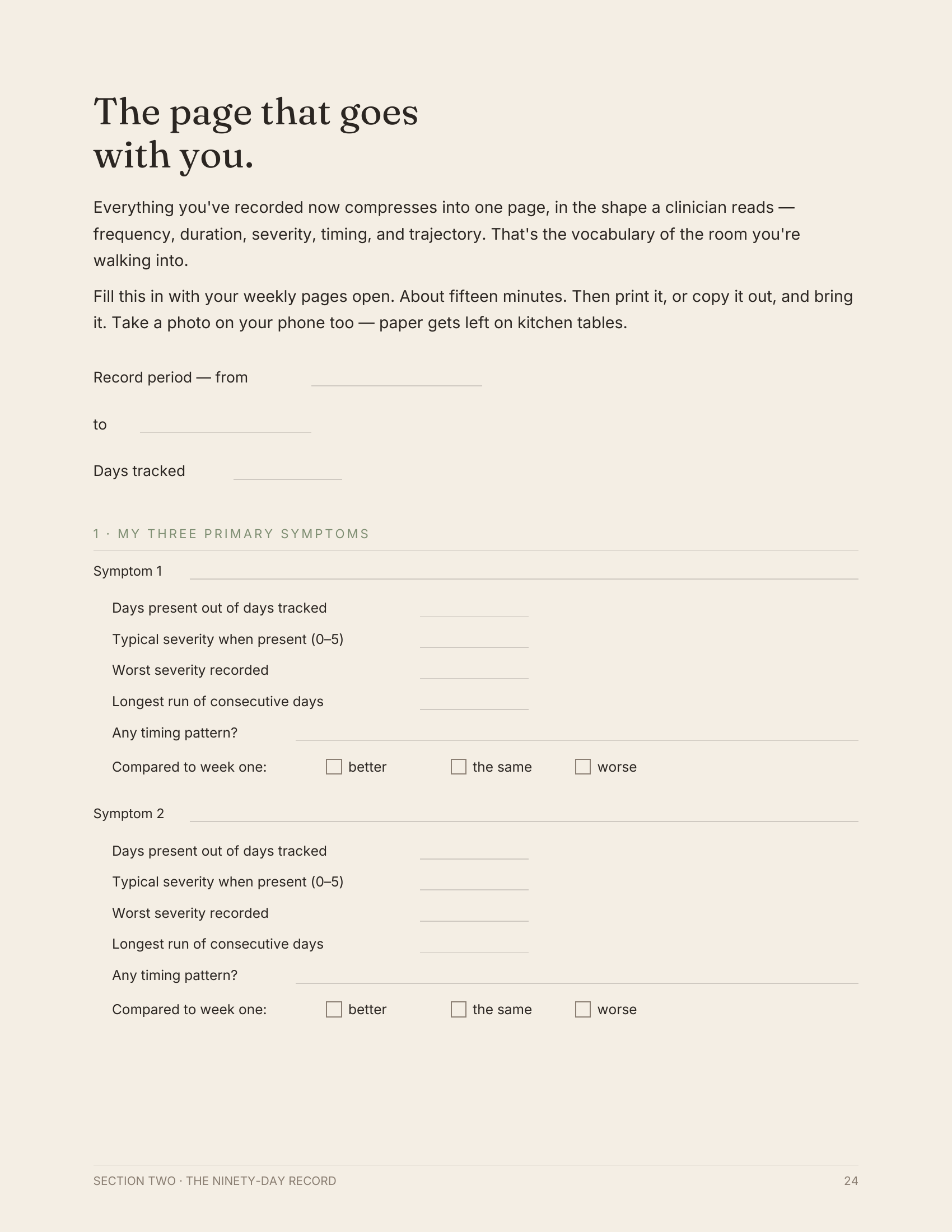
The second one isn’t a matter of being pushier. It’s a matter of having the information organized in the shape a clinician actually works from — frequency, duration, severity, timing, trajectory.
That’s what this kit builds.
The Perimenopause Prep Kit
A 48-page fillable workbook. Fill it in on your laptop or print it and write by hand — it’s designed for both.
It is not a book about perimenopause. There are excellent ones already, and most of them end at the same place: talk to your doctor. This is the part that comes after that sentence.
- Section One
Where you are right now
A 34-symptom inventory, a timeline of what changed when, and an honest page on what it's costing you at work, at home, and in bed. Most women have never seen it all in one place. Seeing it listed is its own kind of answer.
- Section Two
The 90-day record
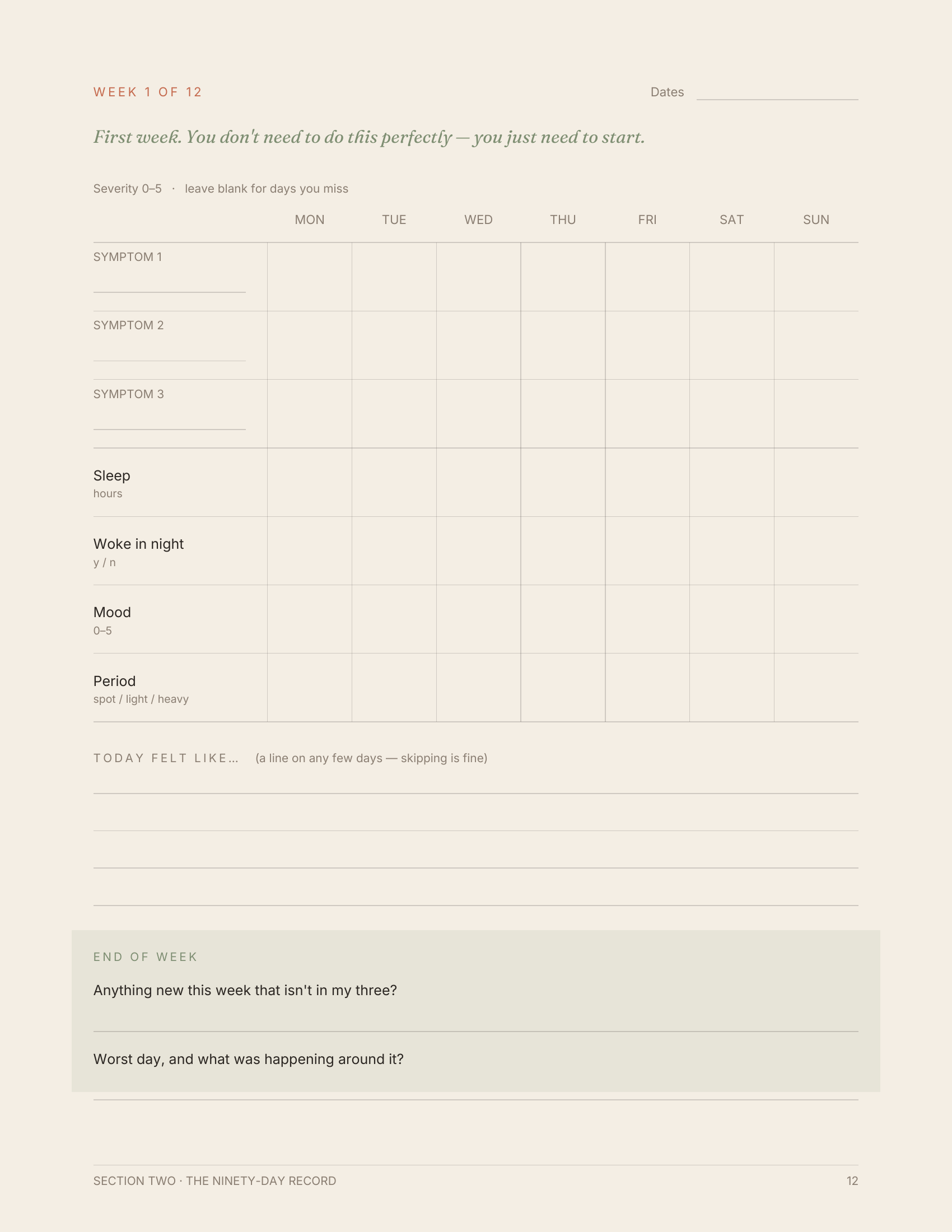
Twelve weekly pages, about forty seconds a day. No journaling, no reflection prompts — twelve boxes and a short line. It ends in the Pattern Summary: one page that compresses three months into the vocabulary of the room you're walking into. This is the page you hand across the desk.
- Section Three
The appointment
Your priorities set before you walk in, so the important thing doesn't get lost at minute nine. A question bank to choose from instead of inventing questions under pressure. Space to write down what was actually said. And the scripts — calm, specific language for the moment you feel dismissed.
- Section Four
Between appointments
Your care team in one place. A parking lot for the questions that arrive at 11pm. A treatment log that answers “how did you get on with it?” with something better than “I think it maybe helped?”
- Section Five
The conversations
What to say to your partner, at work, and to your kids — including the one with your adult daughter that nobody had with you.
Show, don’t tell
The Pattern Summary and a weekly tracker spread — the pages that do the work.
And the sentence most people don’t know they can say
“I understand. I’d still like it noted in my record that I raised these symptoms today, and that we didn’t pursue further investigation.”
It isn’t a threat. It converts a passing dismissal into a documented clinical decision, and it puts your concern permanently in your notes for whoever reads them next.
There are eleven more like it in Section Three.
Who it’s for
This is for you if…
- ✓You've been told it's stress, or your age, or that you should try sleeping better
- ✓You have an appointment coming up and you don't want to waste it
- ✓You've had one that went badly and you're not sure how to make the next one different
- ✓You want to walk in organized rather than apologetic
It’s not for you if…
- You're looking for a book explaining what perimenopause is — you want a good book, not a workbook
- You want someone to tell you what treatment to ask for. This kit deliberately doesn't. It gets you to your clinician with better information; the decision stays between you and them.
The second list is there on purpose. If this isn’t the right thing for you, I’d rather you know now.
Questions
Can't I just track this in my phone?
You can. Most people stop by week two — which is why the kit is built around forty seconds a day and twelve boxes, with a line at the top of every week that expects you to have missed some days. The bigger issue is that notes aren't organized the way a clinician reads. Ninety scattered entries aren't a pattern. The Pattern Summary is.
Is this medical advice?
No, and that's deliberate. This kit doesn't diagnose anything, doesn't treat anything, and doesn't tell you what's happening in your body. It's an organizing tool that helps you observe, record, and communicate your own experience — so the qualified person can do their job better. It also flags the symptoms that shouldn't wait three months to be raised.
What if my doctor still doesn't listen?
Then you'll have a documented record, notes on what was said, a request logged in your chart, and a worksheet for deciding whether it's time for a second opinion. That's a much stronger position than the one you're in now. An appointment that goes badly is information, not failure.
I've already been tracking for months.
Then start with Section Three. The appointment prep, question bank, and scripts work on their own — and you can drop what you already know into the Pattern Summary.
Instant download.
$19
One-time. No subscription.
- 48-page fillable PDF — type into it or print it
- 12 weekly tracker pages, and the Pattern Summary
- The full question bank and the dismissal scripts
- The appointment-day cheat sheet, designed to print and carry
- Yours permanently, including any updates
The next appointment is the one this changes.
You can walk in the way you did last time, and hope it goes differently.
Or you can spend forty seconds a day for the next three months and walk in with a record — the thing almost nobody brings, and the thing that’s hardest to wave away.